Birth · 22 November 1917
Birth of Andrew F. Huxley
Born in Hampstead on 22 November 1917, Andrew Fielding Huxley became one of the leading physiologists of the twentieth century. He combined experiment, mathematics and instrument making. With Alan Hodgkin, he quantitatively described the ionic currents that generate the action potential, then investigated activation and contraction in striated muscle.[1]
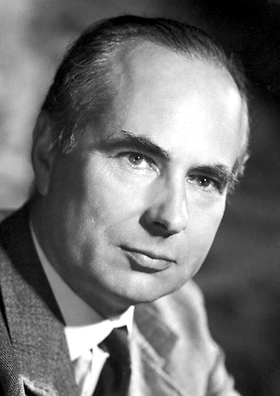
Credit and rights
Auteur inconnu / Nobel Foundation, via Wikimedia Commons · Public domain
Original source · LicenceKey dates and milestones
- 22 November 1917
Born in Hampstead, London.[1]
- 1939
With Alan Hodgkin, he records the action potential from inside the squid giant axon.[1]
- 1946–1952
The pair measures sodium and potassium currents and formalizes their dynamics.[1]
- 1952–1958
Huxley studies electrical activation and muscle contraction.[1]
- 1963
He shares the Nobel Prize in Physiology or Medicine with Alan Hodgkin and John Eccles.[1]
- 1980–1985
He serves as President of the Royal Society.[1]
Contributions to medicine
Documented anecdotes
The physiologist as instrument maker
A lathe received in childhood sustained his interest in mechanics; he later built several instruments needed for his research.[1]
Documentary sources
- Andrew Fielding Huxley (1917–2012)
The Journal of Physiology / PubMed Central